
Camden County Probate Records Office
Probate in Camden County is handled by the Clerk of Superior Court, not by a standalone probate court. North Carolina commonly places estates, wills, guardianships, and many special proceedings under the clerk's authority. The local office is the Camden County Clerk of Superior Court at the Camden County Courthouse, 117 NC Hwy 343 North, Camden, NC 27921. Mail goes to Camden County Courthouse, PO Box 219, Camden, NC 27921. The phone number for the clerk and courthouse is 252-336-4000.
That office is the main local source for Camden County probate records when a person needs to open an estate, file an original will, qualify as a personal representative, request copies, or check a paper file that does not appear in online search. The Judicial Branch public records request path is a fallback for existing Judicial Branch records outside standard case access, but estate copy questions should start with the Camden County Clerk of Superior Court.
Camden County Clerk of Superior Court
Estates and Special Proceedings
117 NC Hwy 343 North
Camden, NC 27921
252-336-4000
Mail: PO Box 219, Camden, NC 27921
Search Camden County Probate Records
The research identifies the NC eCourts Portal as the online starting point for civil, special proceeding, and estates case information where available. Portal is useful for basic case lookup, but it is not the same as the full estate file in the clerk's office. Older Camden County probate records may be paper-only or may need a clerk search. Certified copies also come through the clerk, not a screenshot or informal online printout.
Portal can help confirm that a Camden County estate or special proceeding exists, but probate work often turns on documents that must be reviewed in file context. A will, inventory, accounting, creditor claim, or order may have filing status, redactions, or access limits that are not clear from a case summary. When the record will be used for banking, title work, estate administration, or a dispute, ask the clerk which certified copy or letters are required before relying on an online entry.
- Start with Portal and search for estate or special proceeding case information by name or case details where the interface permits.
- Use Camden County as the local filter when a county filter is available.
- If the record is not visible, if it is old, or if a certified copy is required, contact the Clerk of Superior Court.
- For deed recording, vital record copies, or land records connected to an estate, use the Register of Deeds instead.
- For existing Judicial Branch records outside standard case access, use the state public records request path as a fallback.
The public records statute image is from North Carolina General Statutes Chapter 132.
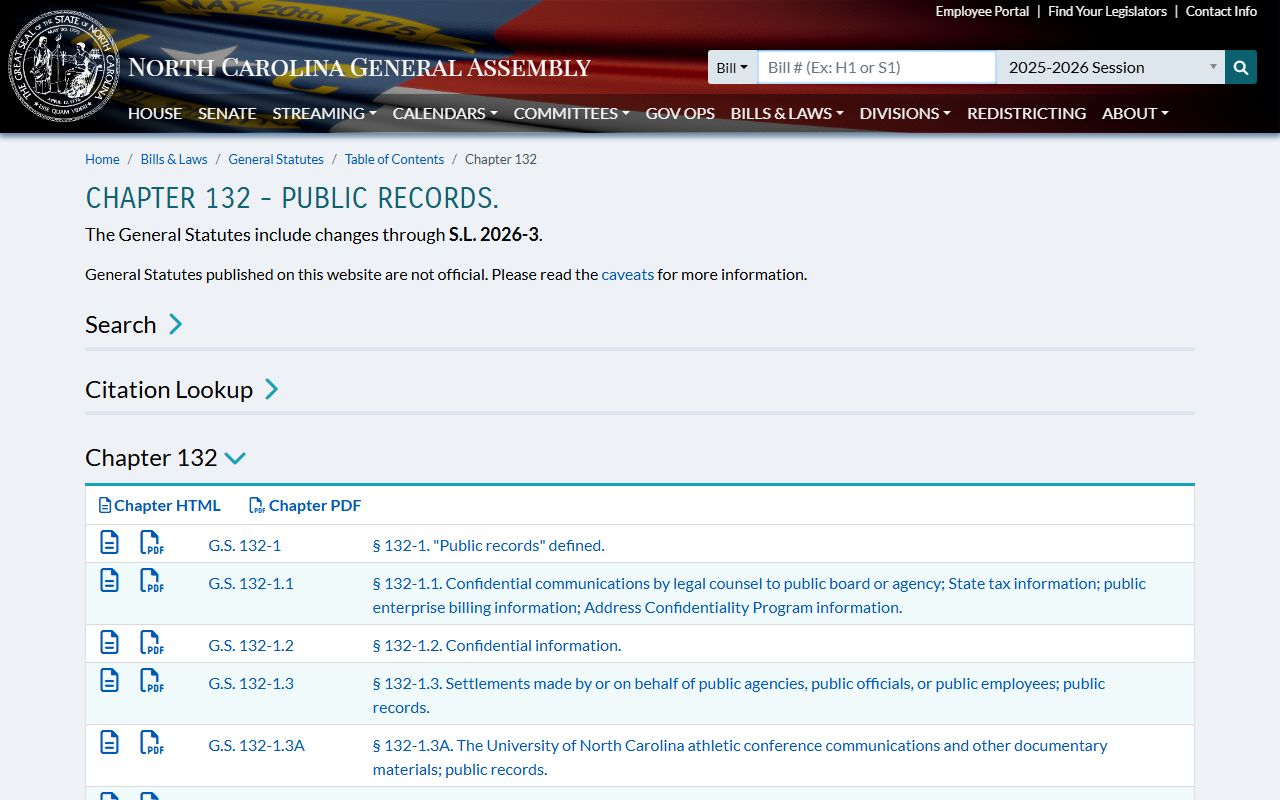
Chapter 132 supports public access to many government records, while Camden County probate records still remain subject to court rules, seals, redactions, and statutory limits.
File Camden County Probate Records
Estate administration starts with facts that tie the matter to Camden County. The person handling the estate must determine whether a will exists, whether the decedent lived in Camden County, and whether the decedent owned property that requires a Camden filing. The clerk can confirm which estate opening papers are needed. If a will exists, the original will is normally filed with the application.
Once the clerk qualifies the personal representative, that representative gives creditor notice, gathers estate assets, files inventory, pays valid claims, distributes remaining property, and files accountings or final papers with the clerk. Contested wills, disputes over estate property, or fights over who should serve may become more formal special proceedings or court matters.
Camden County probate records may also connect to land and vital records after the estate is opened. If the decedent owned Camden County real property, the estate may need recorded deeds or related land instruments from the Register of Deeds. If death, marriage, or family relationship proof is needed, certified vital records may be part of the support file. Those related records do not move the estate out of the Clerk of Superior Court, but they explain why estate research often uses more than one county office.
- Determine whether there is a will and whether Camden County is the correct county for the estate.
- Contact the Camden Clerk of Superior Court to confirm the required estate opening papers.
- File the application and original will if a will exists.
- Qualify the executor or administrator after the clerk confirms the requirements are met.
- Give creditor notice, gather assets, file inventories, pay valid claims, and distribute property.
- File accountings and final estate papers with the clerk.
The will depository source appears in the image from G.S. 31-11.
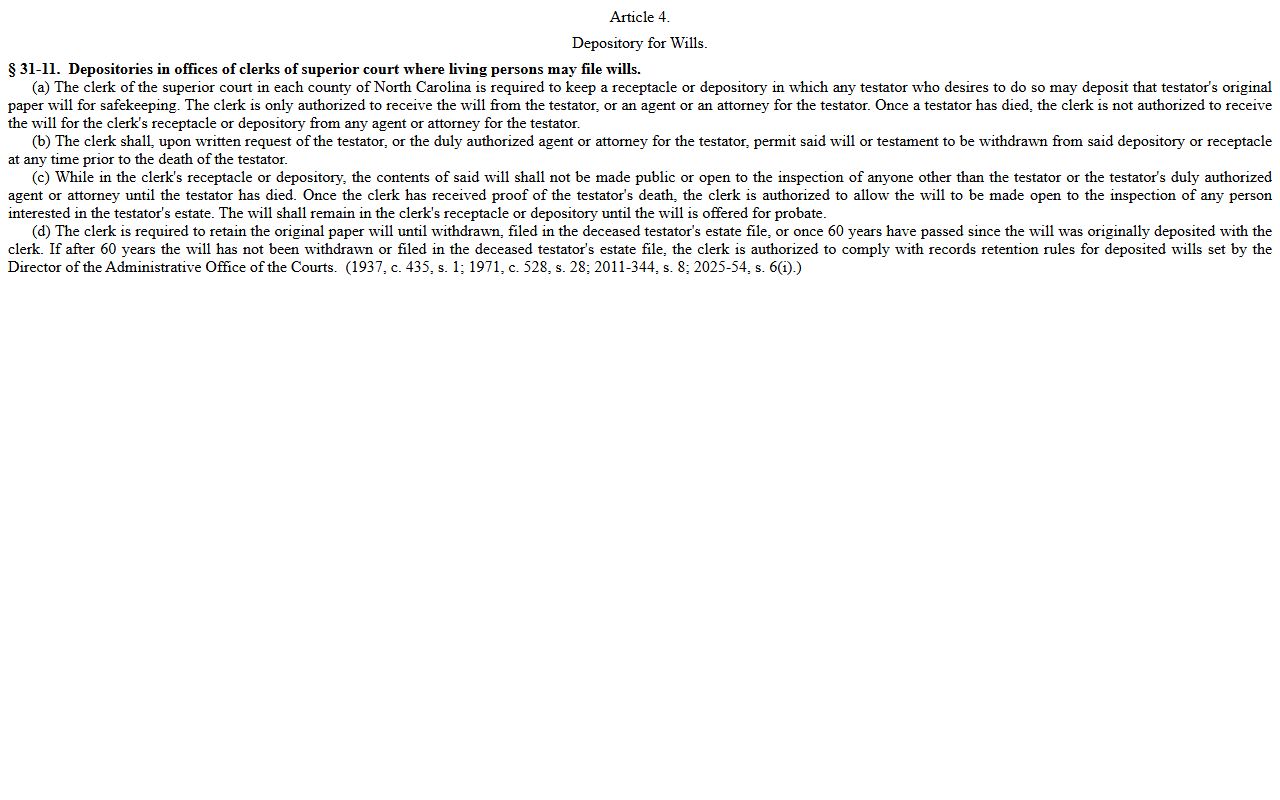
G.S. 31-11 matters because clerks of superior court keep will depositories, with access limits before the testator dies.
Note: A will held for safekeeping before death is not the same as a public estate file opened after death.
Camden County Probate Record Types
Camden County probate records can include more than a will. A typical estate file may hold an application, order qualifying an executor or administrator, creditor notice, inventory, accountings, orders, receipts, and final distribution papers. Guardianship records may involve adults or minors. Special proceedings can touch estates, property, partitions, or disputes that North Carolina law assigns to the clerk or Superior Court context.
Access is not identical for every probate-related category. Routine estate filings may be available through the clerk, but guardianship records, protected personal identifiers, sealed documents, and sensitive filings can be restricted or redacted. The research also places juvenile, mental health, sealed, and expunged court records outside ordinary public inspection. For Camden County probate records, that means a file can be partly public and partly limited, especially when minors, incapacity, or protected financial details are involved.
| Record Type | What It May Show |
|---|---|
| Will | The testator's written directions, witnesses, and filing status after death. |
| Estate application | Decedent, heirs, applicant, property estimate, and requested authority. |
| Qualification papers | Executor or administrator authority issued by the clerk. |
| Inventory | Assets reported to the court during administration. |
| Accounting | Estate money received, spent, distributed, or still held. |
| Guardianship filing | Guardian appointment and oversight for a minor or incapacitated adult, subject to access limits. |
North Carolina fee and copy rules are reflected by the image from G.S. 132-6.2.
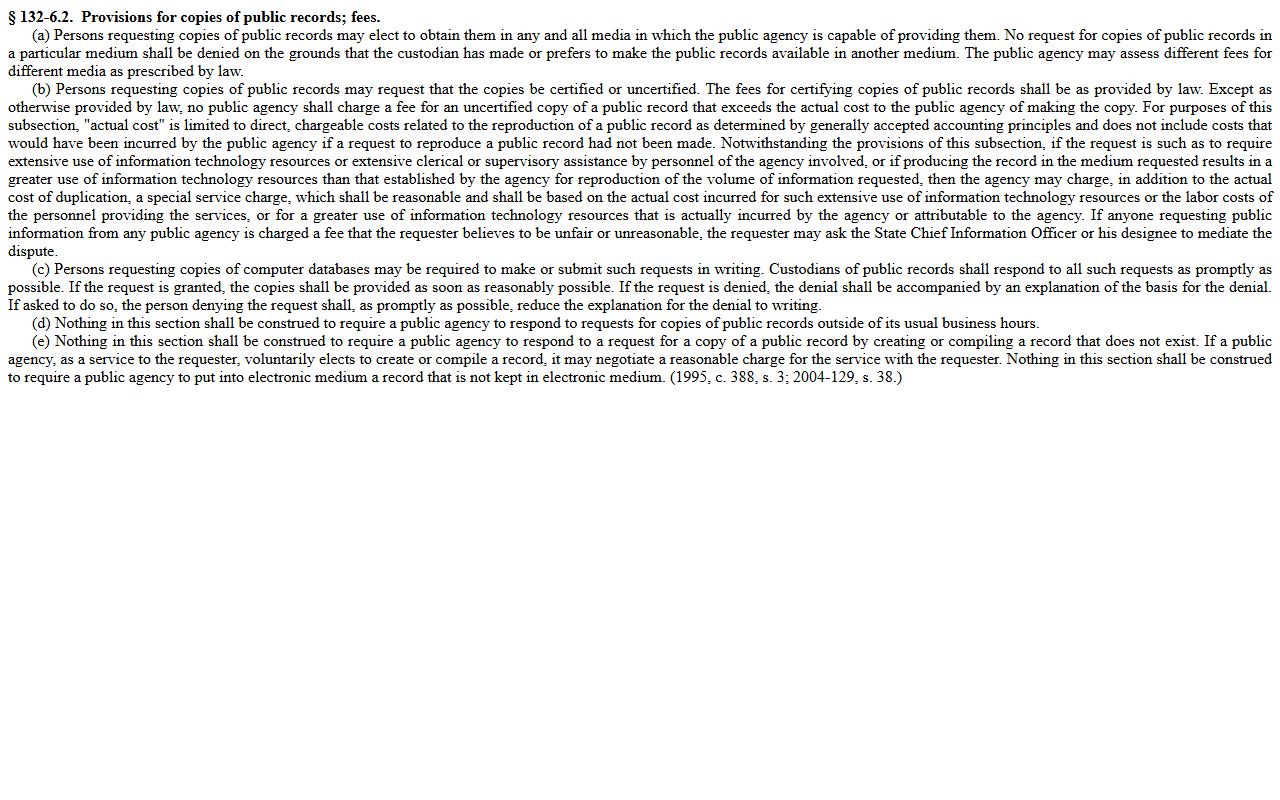
G.S. 132-6.2 supports lawful copy fee rules, which is relevant when Camden County probate records are requested from an official office.
Camden County Probate Fees
The research did not locate a Camden-specific estates filing fee schedule. Filing costs should not be guessed. The safe rule is to confirm estate filing costs, certified copy charges, and payment methods with the Clerk of Superior Court before filing or ordering. Some estate work also requires documents outside the court file, such as recorded deeds, plats, powers of attorney, or vital record copies. Those items are handled by the Camden County Register of Deeds.
The Register of Deeds fees are still useful for probate planning because estate administration can require certified death certificates, deed copies, plat copies, or recorded instruments. The Register of Deeds publishes $10 certified vital records, $5 for the first page and $2 for each extra page of certified document copies, and $0.20 non-certified office copies. Those fees are not estate filing fees, but they are documented Camden County costs that can arise beside an estate case.
| Related Record or Copy | Published Amount | Office |
|---|---|---|
| Certified vital records | $10 each | Register of Deeds |
| Certified document copies | $5 first page, $2 each extra page | Register of Deeds |
| Non-certified copies | $0.20 per copy in office | Register of Deeds |
| All other recorded documents | $26 first 15 pages, $4 each extra page | Register of Deeds |
| Estate filing costs | Confirm with clerk | Clerk of Superior Court |
The Register of Deeds online land search image comes from Camden County Register of Deeds Online Land Search.
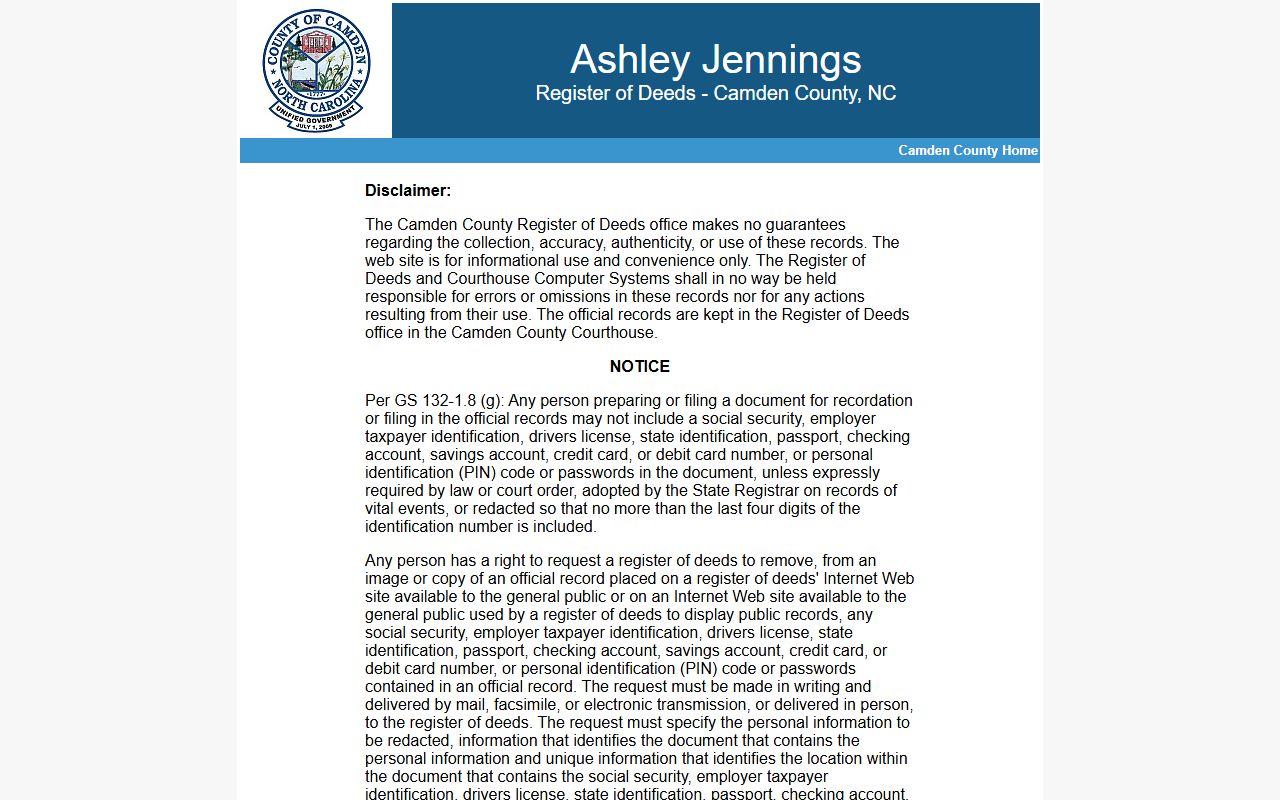
The land search is not the probate court file, but it can matter when Camden County probate records involve real property, deeds, or estate transfers.
Camden County Probate Glossary
Probate terms can be dense, and North Carolina uses clerk-centered estate language. These short definitions help separate the people, filings, and reports that may appear in Camden County probate records.
- Testator
- The person who made a will.
- Executor
- The person named in a will to administer the estate.
- Administrator
- The person appointed when no executor is available.
- Intestate
- Dying without a valid will.
- Inventory
- A list of estate assets filed during administration.
- Accounting
- A report showing estate money received and spent.
- Guardian
- A person appointed to handle personal or financial affairs for a minor or incapacitated adult.